Steve Jobs: Not the First Scientific Thinker

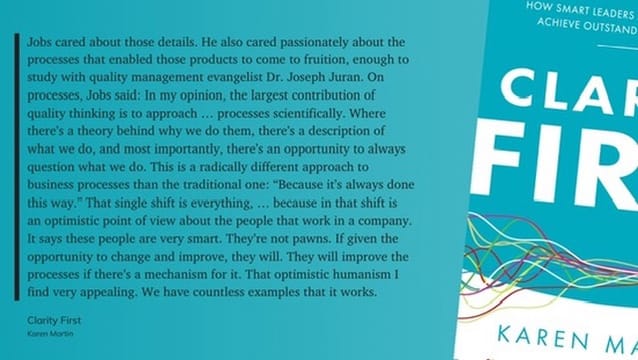
I’ve been an avid user of Readwise to sync ebook highlights, review a selection daily and export to Obsidian. For some time, taking one retrieved highlight every day (wish me luck) and being inspired to write a blog article has been on my to-do list.
I encourage you to see this as a book recommendation from which the highlight came.
Many will know I am an Apple nerd, a Steve Jobs fan, so how poignant that the first in this series relates to Steve Jobs. More so, linking to quality management and one of my other gurus, Dr Joseph Juran.
Detail is in the Process
Any outcome relies on the process. That’s why it is important to understand your current process before focussing on the outcome:
- First, do you have a process?
- Is it documented?
- Is it followed?
- Does it reflect the actual work, the needs of the work?
- Has it been standardised?
The standard drives innovation
Once we have standardised processes, stable outputs, it is time to be creative, have ideas to test whether they lead to improvement.
This starts with questioning how we approach our processes. Giving our team members the permission to challenge how things are done, test their change ideas using Plan-Do-Study-Act (PDSA) cycles ie Scientific Thinking starting with a question to answer through testing hypotheses.
As Steve Jobs encouraged, break away from the change-resistance manifested as the attitude of “this is how it’s always been done here”.
Go back to your process and test change ideas
Map your process, look at your current process measures and capability, define a target state and test your change ideas.
Let me know examples where you've made the leap!
References
Martin KM. Clarity First: How Smart Leaders and Organizations Achieve Outstanding Performance. New York: McGraw-Hill Education; 2018.
Click here for more information about Readwise.