What should we be doing instead of Projects?

Happy New Year. I wish you health, curiosity, and just enough discomfort in 2026 to keep learning.
After a properly restorative festive break, I’m rebooting my blog—nudged, once again, by highlights resurfacing through Readwise. If you rely on an e-reader and pipe highlights into a PKM system like Obsidian, it’s a quietly powerful tool. (No hype. Just useful.)
Which brings me to something that keeps resurfacing too.
Projects.
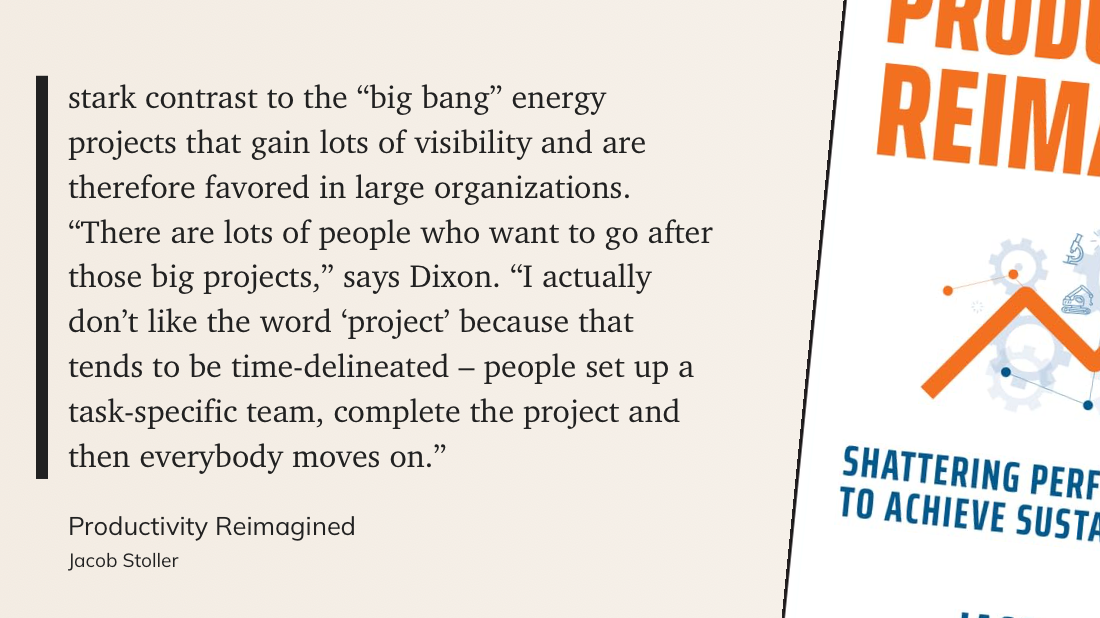
I came across this excerpt from Jacob Stoller’s Productivity Reimagined via Readwise, quoting Stephen Dixon, an energy consultant from Ontario whose thinking aligns well with mine.
What is a project, really?
We talk endlessly about projects.
We manage them.
We staff them.
We celebrate delivering them.
But before we argue about whether we need them, let’s do the boring-but-essential quality thing first: define our terms. Operational definitions matter—otherwise we’re just arguing with shadows.
According to the Project Management Institute (PMI):
“A project is a temporary endeavour undertaken to create a unique product, service, or result.”
Read that again. Slowly.
Two words do most of the damage here:
- Temporary
- Unique
Temporary means it ends.
Unique means it’s one-off.
Hold onto that.
Why we don’t need “projects” for improvement
Yes, I can already hear the objections.
“Are you saying we don’t need improvement projects?”
“Don’t we need projects to deliver change?”
Yes.
And no.
(Welcome to the discomfort.)
I regularly coach teams to think of improvement as continual, embedded, and part of everyday work. And yet—ironically—this coaching almost always happens inside a project structure.
That tension should bother us. It bothers me.
Because if we accept the PMI definition, then a “project” is—by design—the opposite of continual improvement. It has a start, a finish, a handover, and a polite round of applause before everyone goes back to business as usual.
But improvement is not supposed to end.
If it ends, it wasn’t improvement. Certainly not continual.
It was an intervention.
(And yes—continuous vs continual matters. I’ve written about that before - click here.)
So if not projects… then what?
Let’s be clear: this is largely semantic. We are not going to purge the word project from our organisations. HR won’t allow it. Finance definitely won’t.
You will be invited onto project teams.
You will be given Gantt charts.
You will be asked for milestones and closure reports.
Fine. Play the game.
But don’t lose the plot.
Improvement should never be a bolt-on activity, quarantined inside a project team and time-boxed to make leadership comfortable. It should be how the work is designed, how problems are surfaced, and how learning is sustained after the “project” supposedly ends.
So when you’re pulled into a project:
- Challenge the assumption that it ends
- Design feedback loops that survive the handover
- Shift the conversation from delivery to capability
- Ask who owns improvement after the project dissolves
Use the project as a vehicle, not the destination.
Because the real work of improvement doesn’t live in projects.
It lives in the system, a continual existence.
References
Stoller J. Productivity reimagined: shifting the paradigm from working harder to working smarter. Toronto (ON): Figure 1 Publishing; 2020.
Buy Productivity reimagined on Amazon UK or Amazon US
(Affiliate links - thank you for your support).
Click here for more information about Readwise.
Click here for more information about Obsidian.
Deming Network
Join our Deming Network hosted by the Chartered Quality Institute - click here.
Check out the LinkedIn Group for the CQI Deming Network and the YouTube channel.