Read carefully: not everything went wrong in this failure!

In healthcare we obsess over what went wrong — and rightly so. Harm matters. Lives matter. But somewhere along the way, we’ve developed a blind spot: we forget how much we learn from the things that go right.
We dissect failure under a microscope while success quietly walks past, unnoticed. Yet every day, people make decisions, spot risks, and take micro-actions that keep patients and staff safe. That’s not luck. That’s the system working.
Always Ask: “What Went Well?”
One of my non-negotiables during a serious incident review is this:
Even when the outcome is tragic, I actively look for the positives:
- What protected the system?
- Who stepped in at the right moment?
- Where did the process behave exactly as designed?
Moments matter
These moments matter. A paramedic who escalated early. A dispatcher who refused to be distracted. A nurse who raised a hand and asked for help before things spiralled. Staff doing their absolute best with the conditions they were are working under.
That’s not “warm and fuzzy.” That’s operational reality.
Failure Doesn’t Mean Total Collapse
A poor outcome does not equal total systems failure. It means something failed — but often many elements didn’t.
In fact, the very reason an incident wasn’t far worse is because parts of the system held firm. Those “Saving Graces” are gold. They reveal resilience, capability, judgement, and human performance under pressure.
Ignore them, and we miss half the learning.
Focus only on the harm, and you distort the story.
Punish the system, and you erase its strengths.
The Quality Rebel Lens
Quality Rebels don’t just look for defects.
We look for signals of strength:
- study what worked, so we can amplify it
- honour the humans who held the line
- recognise that variation goes both ways — it can hurt us, and it can save us
- know that resilience is not an accident; it’s a skill
If more things had gone wrong in the process, the outcome could have been catastrophic. But they didn’t. That matters. A lot.
Because improvement isn’t only about reducing harm.
It’s also about understanding why—despite chaos, constraints, and complexity—things usually go right.
That’s where the real learning lives. And that’s where Quality Rebels thrive.
References
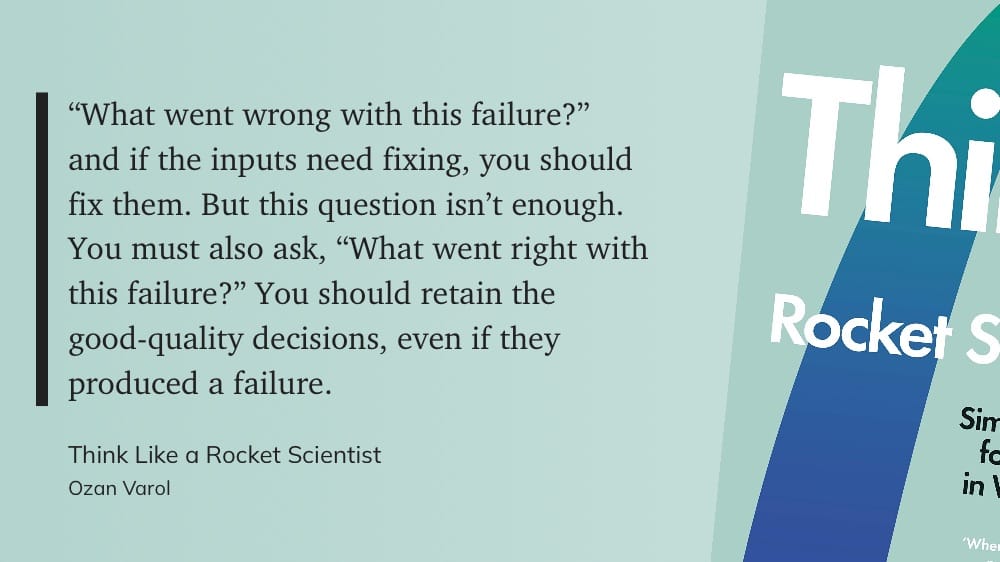
Varol O. Think Like a Rocket Scientist: Simple Strategies You Can Use to Make Giant Leaps in Work and Life. New York: PublicAffairs; 2020.
Buy Think Like a Rocket Scientist on Amazon UK or Amazon US (Affiliate link - thank you for your support).
Click here for more information about Readwise.