From DIKW to DIKUW? Are We Missing Something Between Knowledge and Wisdom?


With a few projects on the go, I’ve been spending a lot of time thinking about data. Not unusual. Collect it. Analyse it. Plot it. Report it. Build dashboards around it. Present it in meetings.
Yet I keep coming back to a phrase that escaped my mouth in conversation with a colleague recently:
DINO. Data In, Nothing Out.
Not nothing in the literal sense, of course. Something always comes out:
- Charts
- Reports
- KPIs
- Monthly summaries
- Beautiful dashboards with colour-coded indicators and trend lines carefully polished for leadership meetings
But often…
- Thinking doesn’t change.
- Learning doesn’t happen.
- System doesn’t improve.
This brings me back to two of my favourite thinkers — Russell Ackoff and W. Edwards Deming.
Ackoff's Pyramid
Russell Ackoff gave us a framework for thinking about the necessary progression from raw facts (data) to intelligent action (wisdom):
- Data → Information → Knowledge → Wisdom
Elegant, simple and, ideally, a flow (but also with feedback loops, think PDSA). Equally, a pyramid with a foundation to build upon.
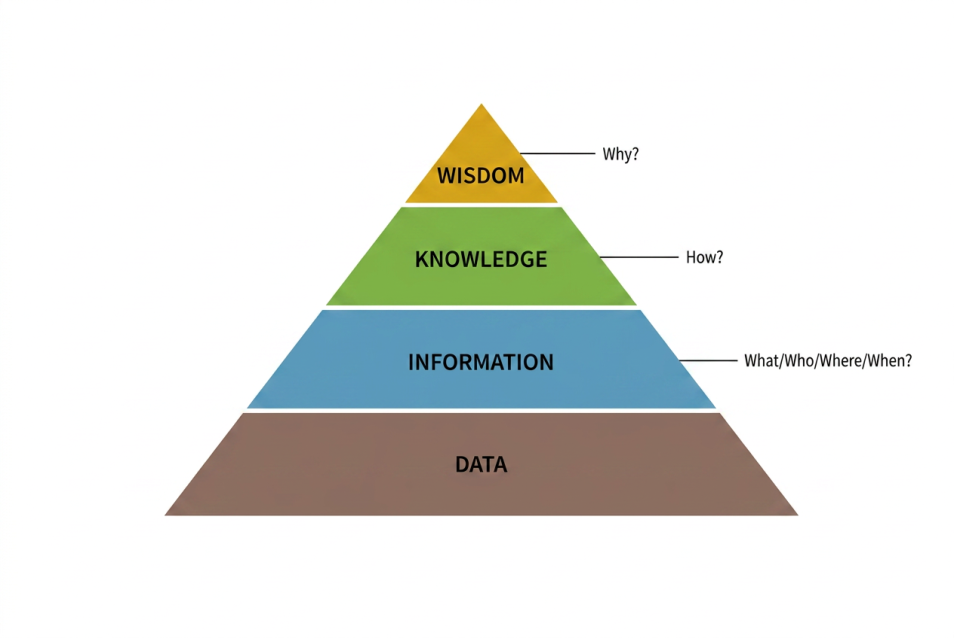
Data is the base. Raw observations without interpretation. For example:
- 42 patient complaints received this month.
Once organised and contextualised, data becomes information — it answers who, what, where, when.
- Complaints by patients increased 18% compared with last month.
When we begin identifying patterns, procedures, and methods, we move into knowledge — it answers how.
- Complaint rates tend to increase during periods of staffing disruption.
And then, at the top, Ackoff placed wisdom. Wisdom is not merely about making decisions. It is about understanding why things are as they are, and what for — which understanding should be acted on, and toward what ends.
The question wisdom asks is not just: What should we do about it?
It is: Do we understand the system well enough to know whether we should act at all?
Deming's Challenge about Knowledge
Deming adds:
There is no knowledge without theory.
In his lectures he made the distinction between information and knowledge:
Information, no matter how complete and speedy, is not knowledge. You cannot — by watching every moment of television or reading every newspaper — acquire a glimpse of what the future holds. Knowledge comes from theory, not from the speed of incoming data.
We live in an era of instant data. Dashboards update in real time. Reports arrive before the last ones have been read. And yet, we may be no closer to knowledge than we were before any of it existed.
Because knowledge, for Deming, has a specific property that data and information do not (at least when the process or system is stable).
A statement, if it conveys knowledge, predicts future outcome — with the risk of being wrong — and fits without failure all observations of the past.
Knowledge reaches backwards and forwards in time. Context and theory based on recent data can help predict near-future performance. Information sits still without these features. New theories can be tested against a prediction, and whether right or wrong, we learn.
Chanticleer, the Sun and the Dashboard
Deming’s classic illustration about the danger of data without theory:
Chanticleer, the barnyard rooster, had a theory. Every morning he crowed with all his energy, flapped his wings. The sun came up. The connection was clear: his crowing and flapping caused the sun to rise, an important responsibility.
Until one morning he forgot to crow. The sun still came up.
Having his theory — even though it turned out to be wrong — allowed learning. His crowing is not necessarily the cause of the sun coming up. Crucially, without his theory, he would have had nothing to revise and nothing to learn.
Now think about your organisation's monthly dashboards.
The complaints data goes up. Everybody in the room begins discussing what happened. Who is accountable. What intervention should be introduced. What performance target has been missed.
But what is the theory? Did it actually go up (remember Special Cause Hallucinations)?
What prediction did we make before looking at this data? What did we expect to see, and why? And what does it mean that we saw something different?
Without a prior theory, the dashboard cannot teach us anything. We are just reacting to numbers. We are Chanticleer, crowing at sunrise — convinced we are causing something, hallucinating the special cause.
Is something Missing in Ackoff's Framework?
Knowing how something works is one thing. Knowing what action should be taken — and whether to act — is something different. Some authors believed there needed to be explicit understanding:
- Data → Information → Knowledge → Understanding → Wisdom (DIKUW)
Knowledge means knowing facts, patterns, and procedures, having context. But understanding means grasping why those relationships exist in the first place, beyond knowledge context . Not recognising patterns. Recognising associations and even causality. Seeing interaction. Understanding context.
Which raises an interesting question.
Did Ackoff miss something?
I Suspect Ackoff Wasn't Missing Anything
The easy answer is to assume Ackoff forgot about understanding, but that probably misses the point.
Ackoff was a systems thinker. And for systems thinkers, why was never a separate stage — it was integral to wisdom.
In Ackoff's own framework, wisdom already carries the why. It is judgement about why things are as they are, combined with judgement about what should therefore be done. Splitting why off into a separate Understanding level dilutes what Ackoff meant by wisdom — it makes wisdom sound like mere decision-making.
Ackoff described wisdom as understanding the consequences of actions over time. That requires grasping relationships, interactions, dependencies, feedback loops, and unintended consequences.
In other words: understanding was already there. It was simply implicit in what Ackoff meant by wisdom. Later writers chose to make it more explicit.
Perhaps it doesn’t need to be?
Is there more than 5S?
Along that thought, I was listening to a podcast in which the hosts were discussing the idea of organisations adding an extra S to 5S to represent Safety.
Summarising, without doing justice to the full podcast (check it out here), each S of the 5Ses actually has safety embedded. Safety is an outcome and shouldn’t be a slogan (Dr Deming’s Point 10 of his 14 Points or Obligations). If an organisation is adding Safety as an extra S, the argument goes that they have a gap in safety culture and leadership commitment.
So, to close this loop, safety does not need explicitly stating as a sixth S, it is implicit, embedded and necessary.
But Perhaps Separating Can Help?
We are extremely good at capturing data, sharing information, even generating knowledge. Perhaps not so good at generating understanding?
We know our incident numbers. We know patient satisfaction scores. We know response times. We know audit compliance rates. We know complaints trends. We know many things.
But do we understand why these patterns exist?
Often not.
Ackoff warned specifically about the trap of confusing measurement systems with understanding the system. The two are not the same thing — and organisations routinely mistake one for the other.
Separating understanding exposes the gap between knowing things and making sense of systems, ultimately on the way to achieving wisdom.
Why separating understanding may be unnecessary
For Deming, understanding is also not a separate stage. It is what happens when knowledge is interpreted through theory. The two cannot be separated, because without theory, you cannot get knowledge in the first place. You only have observations.
Experience teaches nothing without theory. Examples teach nothing without theory. Without theory, there is no question. And without questions, there is no learning.
Deming is saying that without theory, learning is literally impossible. Data piles up. Information accumulates. But the organisation does not progress, improve.
What theory does — and this is the connection to Ackoff — is make understanding possible. Theory gives you something to compare your data against. It gives you a prediction. And when reality diverges from that prediction, you have the raw material for genuine learning.
This is also why Deming's PDSA cycle begins with Plan — with theory. The Plan stage is not about writing an action plan. It is about articulating your prediction: if we do this, we expect to see that, because of this causal mechanism. The Do stage tests the theory. The Study stage compares what you predicted with what actually happened. The Act stage revises the theory.
Without the Plan — without the theory — the cycle collapses. You are not doing PDSA. You are doing DA. Trial and error. And trial and error, as Deming showed, can make things considerably worse.
The Dashboard Delusion
Consider a monthly executive meeting. A dashboard appears on screen. Patient complaints are up. Staff turnover is rising. Response times have slipped. Patient satisfaction scores have fallen.
The room immediately begins discussing the numbers. What happened? Who is accountable? What intervention should be introduced?
The presence of data creates the illusion of understanding.
But what about deeper questions?
Why are these patterns emerging? What theory do we have about how our system produces these results? What interactions in the wider system are generating this variation? What constraints, dependencies, feedback loops, or design flaws exist beneath the visible metrics?
Deming would add another dimension entirely. Before asking what the data shows, we should ask: is this variation telling us something, or is it just noise? Are we looking at common causes — the normal behaviour of a stable system — or a genuine signal that something has changed?
Without theory, we cannot answer that question. And without answering it, every intervention risks making things worse. The engineers at the nuclear tube factory spent two and a half years trying to find the cause of every defect in a stable system. Their efforts had no effect — not because they worked badly, but because they had no theory. Every defect was treated as a special cause. Most were not. They were tampering.
The dashboard gave us information. Perhaps even knowledge. But understanding never happened. And yet decisions were made anyway.
Senge Would Probably Be Unimpressed
Peter Senge, in The Fifth Discipline, argued that true learning organisations do not simply accumulate information. They develop the capacity to think differently. To see interrelationships rather than isolated events. To recognise patterns over time rather than reacting to snapshots. To understand systems.
This is precisely where many organisations fail. We have become extraordinarily good at measuring events. Terrible at understanding events within a systems perspective. We monitor symptoms while remaining blind to structure and root causes.
I Plotted The Data — Look What It Shows!
This connects with something I have said many times to colleagues.
When somebody presents data in a slide deck and then immediately spends five minutes explaining what the graph means… I become suspicious.
My belief has always been simple. A well-designed visualisation should communicate its message without requiring interpretation from the presenter.
But perhaps I have been wrong.
Perhaps even the clearest visualisation cannot solve the deeper problem. Because visualisation is still not understanding. A graph can show us what happened. It rarely tells us why. And without a prior theory, we cannot even be sure what question we are asking of the data.
Deming again:
The planning stage is the most important of all. People short-circuit it — they cannot wait to get into motion. They want to look busy. Do not short-circuit that planning stage. It is the foundation of everything.
The graph on a slide is the Do stage. Most organisations never did the Plan. There’s no theory to base understanding and learning on.
The DINO Problem
This brings me back to DINO. Data In, Nothing Out.
Not because nothing is produced. Plenty is produced. Reports. Dashboards. Metrics. Board papers. Incident summaries. Lessons learned databases. Policy documents.
But none of these guarantee understanding.
And without understanding, wisdom remains impossible.
The organisation knows what happened. It may even know how something happened. But we still might not understand why.
Ackoff's real takeaway was this: knowledge is not the accumulation of information. It is the ability to take effective action based on understanding. Not more metrics. Not more reports. Not more dashboards. But better thinking, better interpretation, and better decisions.
Deming's equivalent: there is no knowledge without prediction. A statement devoid of rational prediction conveys no knowledge.
Both suggest a possible gap between an organisation that has data and an organisation that has theory. Between one that measures and one that genuinely learns. Both Ackoff and Deming ultimately prompted us to think about our own systems, think in different ways to the accepted norms of management, leadership and problem-solving.
A Better Question
Perhaps we need to stop asking:
What does the data show?
And instead ask:
What did we predict — and what does it mean that we saw something different, or not?
And even more importantly:
What has changed in our thinking because of this information?
Because if nothing changes in how we think — if no theory has been tested, refined, or revised — then we might not be moving towards knowledge and wisdom?
DINO. Data In, Nothing Out.
A danger facing us is not poor quality data. It is arriving at every meeting without a theory — and leaving without having developed one for testing.
Are mistaking the measurement system for understanding the system?
And confusing the presence of data with the presence of knowledge?
References
Ackoff, R.L. (1989). From data to wisdom. Journal of Applied Systems Analysis, 16, 3–9.
Ackoff, R.L. (n.d.). Change [4-cassette audio series]. Hosted by Lloyd Dobbins; produced by Claire Crawford Mason.
Deming, W.E. (1982/1986). Out of the Crisis. MIT Press.
Deming, W.E. (1994). The New Economics for Industry, Government, Education (2nd ed.). MIT Press.
Dyer, J., Saleh, M. (2026). Behind the Curtain podcast: 5S Doesn’t Need a Sixth 'S' for Safety.
Neave, H.R. (1990). The Deming Dimension. SPC Press.
Senge, P.M. (1990). The Fifth Discipline: The Art and Practice of the Learning Organisation. Doubleday/Currency.